Monday, 25 June 2012

Wines from Châteauneuf – Approved by the Pope!

An interesting distinction of French wine is how every region displays its own unique personality. Bordeaux boasts stately chateaux and is the jewel of French wine, having achieved fame early due to its location as a prominent shipping port. At the other end is Burgundy with its image of industrious rather than flamboyant winemakers. During the French Revolution, vast tracts of land were seized from the church and sold off piecemeal, resulting in the fragmented vineyards we see there today. To truly appreciate French wine one has to delve into the rich history of each region.  
 
Châteauneuf-du-Pape, a wine region in Southern Rhône, holds a fascinating story in its past. The name translates to “Pope’s new castle” and refers to a time when the Pope ruled not from Rome, but from the French city of Avignon, a short distance south of Châteauneuf. Many of the Avignon Popes were accustomed to the finer things in life, including wine. The first of the Avignon Popes, Clement V, had a winery in Bordeaux, now known as Château Pape Clément. During their reign, the Popes did much to raise the profile and quality of the wines of Châteauneuf-du-Pape. It is a region that now produces some of the most unique and quirky wines of France.
 
Overshadowed by the more famous regions of France, opportunities to taste wines from Châteauneuf-du-Pape are rare, but thanks to the efforts of J&D Burleigh (well-known for their portfolio of fine Italian wines), those in Singapore were able to sample wines from marquee producers such as Domaine du Pegau and rising stars like Château Simian. Was it coincidence that the tasting was held at the Raffles Hotel Steak House? These rich and alcoholic wines practically begged to be paired with food, and a juicy steak would have fit the bill admirably.
 
With the exception of Château de la Font du Loup, these are classic wines; deeply coloured, concentrated and with perceptible warmth due to the high alcohol content. In fact, Châteauneuf-du-Pape wines have the highest alcohol in France, averaging around 14-16%. This is due to a combination of factors; the warm Mediterranean climate, unique football-sized stones (called galets) that reflect heat and the use of late-ripening varietals. The bottles are stylish and heavy, embossed with the papal coat of arms and keys of St. Peter. Both visually and in taste, they have an air of solemn dignity.
 
Winemaking here has traditionally followed a set path. Low yields in the vineyard to concentrate the flavours of the fruit followed by fermentation in stainless steel or cement tanks (as Grenache, the backbone of the blend, tends to oxidise easily). The wines are matured in old oak barrels or large casks known as foudres. The toasty and vanillin flavours of new oak, common in Bordeaux wines are not welcome here. A staggering 13 varietals are allowed in this appellation, but in practice Grenache, Syrah, Mouvèdre and Cinsault are the most widely used for the reds. White Châteauneuf-du-Pape is somewhat of a rarity, but this tasting included a delicious example made from Grenache Blanc, Roussane, Clairette and Bourboulenc.
 
Céline Sabon of Clos du Mont Olivet had this to say about the philosophy of Châteauneuf-du-Pape: “Châteauneuf still has that peasant mentality which places a big emphasis on friendship. We are not that good on marketing, but I think that many people like our wines because they know the owner is working in the vineyards. It is a good quality of CDP because we speak from the heart.”

Winery profiles and tasting notes: 
Laurence Ferraud and her daughter
Domaine du Pegau
One of the superstars of the appellation, in the same tier as Château Beaucastel and Château Rayas. The winery was established in 1987 by Laurence and her father Paul Ferraud. Although sales were tough during the initial years, by 1992 the wines had achieved critical acclaim and were being sought out by wine collectors around the world.

The Cuvée Réservée line is made using ultra-traditional methods, forgoing de-stemming and temperature control for better extraction. Natural yeasts were used during fermentation and the wines are aged for two years in old oak casks. The Cuvée Laurence is made from the same blend of grapes, but sees an additional two years aging.
 
Domaine du Pegau Châteauneuf-du-Pape Cuvée Réservée 2007 – Tight and focused, packed with flavours of briary fruit, horse saddle and redcurrants.  
 
Domaine du Pegau Châteauneuf-du-Pape Cuvée Réservée 2008 – A pronounced nose of black cherries, ripe black fruits and earthy tones. Very clean flavours, backed by plump tannins. A savoury, bitter cherry finish.
 
Domaine du Pegau Châteauneuf-du-Pape Cuvée Laurence 2004 – Distinctive nose with notes of spice, herbs, stewed plums and tar. The additional years in oak really shows in this wine, giving it a more aged character and sacrificing primary fruit flavours for complexity.
 
Château de la Font du Loup
Helmed by the bubbly Anne-Charlotte Bachas, the wines are as irreverent as the winemaker herself. At first glance, the hilltop location and north facing orientation of the vineyards, coupled with sandy sedimentary soils do not seem conducive to winemaking in this region. As Anne puts it, the reason her great-grandfather chose to buy this particular plot was because of its remoteness and scarcity of neighbours. Her ancestor’s love of isolation has given us a style of wine that is quite unlike the rest of Châteauneuf. It may be an oxymoron to call Southern Rhône wines delicate, but that is what these wines are.
 
Château de la Font du Loup Châteauneuf-du-Pape Blanc 2010 – A refreshing white with notes of mandarin orange, apricot, white flowers and pear. Harmonious and balanced, this wine delivers punchy fruit flavours accented with a delightful perfume. Medium length.  
 
Château de la Font du Loup Châteauneuf-du-Pape 2009 – Aromatic with notes of incense, red fruits, boiled sweets and pepper. Lush and elegant on the palate, with juicy acidity and a profile of red berries.
 
Château de la Font du Loup Châteauneuf-du-Pape Cuvée Le Puy Rolland 2007 – No relation to the Michel Rolland, the parcel of land which provides fruit for this wine was planted by a man who shared the famous oenologist’s last name. The wine is 100% Grenache from vines that have an average age of 90 years. The ’07 had expressive varietal character of strawberries with silky tannins and moderate alcohol. A lasting finish with notes of white pepper.  

Clos du Mont Olivet  
The Sabon family have been making wine in Châteauneuf-du-Pape since the early 20th century and Clos du Mont Olivet is now run by the fourth generation comprising of Thierry, David, Céline and Mylène Sabon. The estate includes 28 ha in Châteauneuf-du-Pape, 17 ha in the Côtes du Rhône and a further 1.5 ha used to make table wine. The geographical distribution of the estate allows for various expressions of terroir.
 
Clos du Mont Olivet Châteauneuf-du-Pape Tradition 2009 – Cranberries and dried raisins on the nose with aromatic lift and spice. Very rich on the palate, but not overripe, maintaining a nice balance between texture and freshness.
 

Clos du Mont Olivet Châteauneuf-du-Pape La Cuvée Du Papet 2009 – This wine is produced only in extraordinary years from 100 year old vines. The ’09 exudes a crystalline purity and ripe, rich fruit character. Both the Tradition and La Cuvée Du Papet employ partial de-stemming, which may explain the plush tannin structure. This seems to me to be a more modern style of Châteauneuf-du-Pape.
 
Château Simian

A winery more known for its Côtes du Rhône range rather than Châteauneuf-du-Pape. 80% of its wines are exported, mainly to the USA and London. This is one of the smaller estates with only 4 ha of vineyards in Châteauneuf.
 
Château Simian Côtes du Rhône Villages Jocundaz 2007 – The vineyards for this wine are planted on a mountainous area with sandy soils. Notes of game, wild berries and raspberries. An easy drinking wine.
 
Château Simian Châteauneuf-du-Pape Cuvée Les Grandes Grenachières d'Hippolyte 2009 –This mouthful of a wine is made from 95% Grenache. Powerful and dense with red berries, raisins and crushed grape skins. Well-balanced with a dry finish.

Friday, 15 June 2012

The WSET Diploma Exams - A Sherlock Holmes Approach

A curious sort of Zen falls over me when I enter an exam hall. It is the result of nerves stretched so taut that they've finally snapped, and a brain deprived of oxygen due to hyperventilation. In this dreamlike, surreal state, everything comes into crystal clear focus, including the minute actions of other candidates. The blonde girl beside me sits with balled fists resting on her lap, knuckles white with exertion. A slight rustle of papers as the person behind me adjusts his sheets. The air is thick with tension. "Five minutes till we begin," says the blue-shirted invigilator.

I am in London, sitting for one of the exams required to complete the WSET Diploma. The past few months have seen a near caveman-like isolation, surrounded by arcane treatises on vino-related matters. I've explored the Caribbean, peered over the shoulders of 19th century monks and engaged in tax rebellions in Scotland. And as a diversion in-between studies, I delved into the life of Arthur Conan Doyle's most famous creation, Sherlock Holmes.

Four minutes. A Nirvana-esque revelation that there is a striking symmetry in the methods of the world's greatest detective and how one should approach a wine exam. Firstly, abstaining from food. Sherlock extols the virtue of starvation in The Adventure of the Mazarin Stone. "The faculties become refined when you starve them... you must admit that what your digestion gains in the way of blood supply is so much lost to the brain. I am a brain. The rest of me is a mere appendix. Therefore, it is the brain I must consider." Sharpened by hunger, I am aware of the myriad scents wafting around me. Fear and anxiety have scents too.

Secondly, the importance of facts. In A Scandal in Bohemia, Sherlock advises that "It is a capital mistake to theorize before one has data. Insensibly one begins to twist facts to suit theories, instead of theories to suit facts." This is a common error when tasting wines, one that is highlighted repeatedly by the examiners. A candidate forms a conclusion about what the wine is before evaluating all its components. Inaccurate data is then entered to justify the false inference. As the tasting samples make their way around the room, I focus only on what I see.

Three minutes left, and a third lesson. In The Boscombe Valley Mystery, Sherlock solves the case by noticing that the murderer's footprints pointed to a lame person. "You know my method," he says. "It is founded upon the observation of trifles." Many a candidate has been led astray by rashly reading through the exam questions. A case in point is the unfortunate soul who misread Austria as Australia and proceeded to submit a lengthy essay almost entirely opposite to what was required.

Two minutes. "Everything in this world is relative, my dear Watson." Tasting blind is very much like solving a mystery. Follow the clues without bias. Build upon the evidence, looking for the threads that link them. A singular piece of data, viewed in isolation, can be misleading. "It may seem to point very straight to one thing, but if you shift your own point of view a little, you may find it pointing in an equally uncompromising manner to something entirely different." Is high acidity the result of a cool climate, varietal character, or manipulative winemaking? Without taking into account the other elements of a wine, all are reasonable conclusions.

As the final minute ticks down, I am acutely aware that I am more Watson than Sherlock. Jet lag gnaws at the edges of my senses and I struggle to recall facts memorised just a day before. Yet it is a comforting thought that these exams are based on a foundation of logic and systematic assessment. The ghost of Sherlock imparts a final guidance before he leaves me to my trials. "You know my methods. Apply them."

Thursday, 26 April 2012

Presenting Her Majesty, The German Wine Queen!


German Wine Queen - Annika Strebel
The message has oft been repeated; German wine has changed. The sweet, fruity whites of yore have been replaced by delicate, bone dry styles with steely acidity and complex flavours. Serious reds, based on the Pinot Noir varietal, are being crafted in regions such as Ahr and Baden. The buzzword now is quality rather than quantity. 

Caviar canapés. An excellent start at BLU.
Admittedly, the message gets through far more effectively when presented by the lovely Annika Strebel (Germany’s newly anointed Wine Queen) than by a stuffy wine writer. I had the pleasure of meeting this poised and articulate woman during a wine dinner jointly hosted by the German Wine Institute (DWI) and local wine merchant Wein & Vin. The latter has been instrumental in bringing top German wine producers such as Dönnhoff and Meyer Näkel to our sunny shores. 

Feminists may express outrage at the idea of using a beauty pageant to promote an industry, but the road to becoming a German Wine Queen involves more than just looks. The contestants, who hail from each of Germany’s 13 wine-growing regions, must speak on a multitude of wine-related issues in front of a jury of 80 professionals from the wine industry, politics and the press. This helps them to prepare for the ambassadorial role of a German Wine Queen. The ability to answer questions about German wines confidently and competently is a necessary skill for the winner, who will be speaking at over 200 engagements around the world during her reign. 

These engagements will bring Annika to many locations around the world. Singapore is in fact her first international stop before going on to Beijing. While she was here, she participated in numerous events as part of the first ever “Riesling Week” held from the 14th to 22nd of April and gave a talk at the Wine & Spirits Asia exhibition. She tells me of one of her more unusual events, involving an underwater wine tasting in Germany. Weighed down by a heavy belt and surrounded by photographers, she confided that she had a slight worry about choking as the belt would have prevented her from quickly ascending to the surface. But like a true professional, she handled the event with ease and her trademark vivacity (for a glimpse of this surreal setting, search for “unterwasser weinprobe Annika” on Youtube). 
Annika charming the audience

Annika’s favourite varietal is naturally Riesling, a grape that has naturally high acidity and ages well. She is also partial to Silvaner, a little-known German varietal that finds its best expression in Annika’s home region of Rheinhessen. As befits her royal title, Annika is a staunch nationalist and believes that the native varietals of Germany should be promoted over international ones such as Chardonnay and Cabernet Sauvignon. “We should concentrate on our competencies,” she asserts. “If we make Cabernet Sauvignon like the French, we can be as good as them but not better.”

Besides having a sharp palate when it comes to wines, Annika displays a keen interest in food as well, frequently enquiring on the ingredients of our dinner menu. She was excited about trying out Singapore’s local specialities such as chilli crab and laksa, although I was confused when she admitted a distaste for “organics” (I later realised she was talking about organs). Her opinions of the food and wine pairings during the dinner were precise and succinct, displaying an in-depth experience that belied her youthful 24 years. The German Wine Queen competition has been around for a long time (since 1949 in fact), but Annika will be setting a precedent as the first wine queen to engage Asia in a big way. 

Her Majesty's ring representing the German wine regions
Her travelling schedule means that she has had to put her viticultural studies at Geisenheim on hold this year, but once her duties as the German Wine Queen are over, she intends to complete her studies and join the family winery, Weingut Strebel. I ask her what qualities she would look for in a German Wine Prince to aid her work. There is only the briefest of pauses before she replies with a twinkle in her eye, “He’d better be able to help me carry my bags!”

The throne only has room for one. Long live the Queen.

Monday, 23 April 2012

Exploring Wine & Spirits Asia

In 2010 when I went to Wine & Spirits Asia (WSA) I was struck by how lacklustre the event was. Lingering concerns over the economy, coupled with travel issues due to the volcanic ash put a dampener over the exhibition. It still proved to be a fruitful outing for me personally as I made several new friends during that day whom I still keep in contact with. 

This year could not have been more different. There was a palpable excitement in the air and a horde of visitors. Long jams were seen at the entrance to the Expo, and come closing time, the number of people seen at the MRT station would have been enough to make one wonder if the train system had broken down again. Try as I might, I could visit a fraction of the booths during the two days I attended. 


Michael turns part time promoter for Amedei
It was my luck and pleasure to bump into renowned pastry chef Michael Lau while I was there. All I can say is, freebies start appearing when you are accompanied by a person as keen on his craft as Michael is. Listening to him rattle on about complicated production methods is alien to me, but at least I know there's a technical reason why good stuff tastes good.

The wine talks were worthwhile, and I wish that I had time to attend more of them. Local wine expert Lim Hwee Peng, in conjunction with Sopexa, gave a detailed breakdown on the Languedoc-Roussillon region that went into wine styles, terroir and the assorted AOPs (Appellation d'Origine Protegée). Sopexa has long been active in Singapore and I am glad that they are continuing to promote French wine. They were not the only generic body at WSA though. The Deutsches Weininstitut or German Wine Institute were also actively promoting German wines. They had a powerful weapon in their arsenal in the form of Annika Strebel, the attractive 24-yr old German Wine Queen. 


When associating an alcoholic beverage with Singapore, you can't get more iconic than the Singapore Sling, a cocktail created by barman Ngiam Tong Boon at the Raffles Hotel around the beginning of the last century. What I didn't know was that the drink was apparently created for a British colonial to assist in his wooing of a woman at the bar. A fanciful story perhaps, but it adds to the allure surrounding the cocktail. The ingredients for this drink are gin, Cointreau, Grenadine syrup, Dom Benedictine, cherry brandy, Angostura bitters and pineapple juice. Soda water may be added for froth. Nowadays, the cocktail can be found in pre-mix bottles, needing only pineapple juice to complete the drink.

The food and wine events calendar continues to be packed. Next up is the World Gourmet Summit which runs from 23rd April to 3rd May. 

Wednesday, 4 April 2012

Apple and Grapes: A review of iPad Wine Magazines

In the realm of technological gadgets, I would be considered a laggard. I use my devices for years until they give out and then suffer panic attacks trying to transfer my data into new, unfamiliar devices. You know it's bad when your parents ask if you've got WhatsApp and you have no idea what they're talking about. Last year, I was happily tapping on my Palm PDA (does anyone remember what a PDA is? Or Palm?) when the tech gods, fed up at my slow pace of adoption, caused it to slip out my hand (and its casing), subsequently landing face first onto the tarmac. And then a car ran over it.

Cursing (under my breath, as in my pocket was an ancient phone I hoped they hadn't yet noticed), I was forced to queue in line for the then newly released iPad 2. Fortunately, it is a joy to use. A wealth of applications means that the iPad possesses great versatility (although my niece is somewhat disappointed that she cannot find Angry Birds on it). I have found it an indispensable device for taking down wine notes and keeping tabs on appointments.

The large, clearly lit screen also means that the iPad is a great reading device. Despite initial concerns, I have not felt any eye strain from reading articles on it for an extended period. Wine magazines have started to expand into this new distribution channel, with varying degrees of success. Here's a list of some of the magazines available in the App Store.  

1. Decanter Magazine International

Official blurb
Decanter is Europe's leading wine magazine and is read by experts and enthusiasts alike. It has an exciting mix of news, interviews with leading wine personalities, regional profiles, plus recommendations from classic regions such as Bordeaux and Burgundy to the new wine stars of the New World and beyond.

Price
App is free to download, each issue costs US$7.99.  

Review
Decanter is probably the best wine magazine out there, with insightful articles and just the right amount of depth that will appeal to wine novices and experts alike. The iPad version is a straight copy of the print edition, which means that you have to zoom in to read the tiny font. The user interface could be improved. It took me a few tries before I found out that I had to tap on the bottom of the screen to bring up the menu, and if you want to e-mail an article, you have to go through the troublesome process of selecting the part of the article you want to send. There are also a few bugs with the application, for example, sometimes I was unable to scroll down to view all the issues available under the Store page. A sample issue is available. The iPad version is a surprising let-down considering the high quality of the magazine.

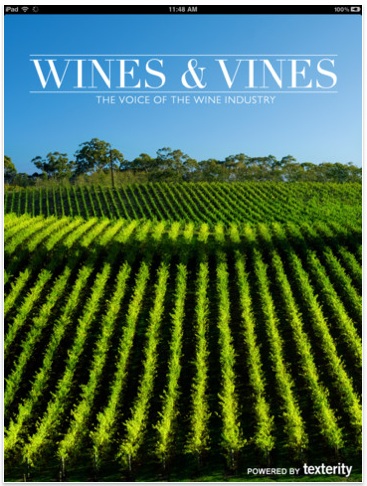
2. Wines and Vines


Official blurb
The Wines & Vines App is the one-stop for wine industry news, articles and wine sales channel data and analysis.

Price
Free

Review
A well written, in-depth look at winemaking. This magazine will appeal to hard-core wine geeks. Each issue is broken into several sections that are easily accessed via the Navigator button on the top left. The magazine makes use of digital features by embedding videos and providing a search function. Articles can be shared on Facebook, Twitter and via e-mail. Technicality of articles can be daunting for the wine novice. A recent issue focused on the use of oak to set tannin structure, improve colour through co-pigmentation and mask the vegetal characteristics of pyrazines. If that last statement didn't cause your eyes to glaze over, this mag's for you.

3. Palate Press


Official blurb
Palate Press is a modern electronic wine magazine, providing the most exciting and interesting wine content available today. Columnists, sommeliers, wine growers and wine lovers all contribute to the magazine, producing weekly feature stories from around the world, along with daily tasting notes, wine advice, and more.  

Price
App is free to download, each issue costs US$0.99

Review
The strength of this magazine lies in its diversity. There are articles on wine science, food pairing, health, wine trends, cocktails, regional reports and a book review, all in one issue. This tends to make the magazine less focused than others reviewed here. The iPad version contains additional content not found on the online version of the magazine. In terms of visual appeal, the magazine looks as though someone pasted everything in a word processor, added a few images and links, and converted it into a pdf. Interesting reads, but not enough value-add compared to just reading off the website.

4. Uncorked


Official blurb
Wine from Grape to Glass. Engaging and accessible coverage of the world of wine from an editor who's actually a vintner himself. Uncorked brings you wine news, discerning reviews, taste tests, and unexpected but delicious food pairings. You'll also get plenty of luscious photos and behind-the-scenes stories from vineyards and winemakers around the world.

Price
App is free to download. Subscription plans cost US$0.99 a month or $9.99 a year (for 48 issues).

Review
Beautiful, vivid photographs and accessible articles make this magazine a joy to browse through. The display is optimised for the iPad and is thus easy on the eyes. The content is well-organised; divided into news, human interest and tasting notes. It makes nifty use of the iPad features by embedding videos and slideshows, making reading a truly interactive experience. With several free issues available and a wallet-friendly subscription plan, this is a worthwhile addition to the wine lover's digital library. 

5. James Halliday's Wine Companion


Official blurb
The NEW James Halliday’s Wine Companion ipad magazine is essential reading for both new and established Australian wine lovers. The magazine features articles by James Halliday (who better to explain how to taste wine than the great man himself?), the most sought-after wine reviews, travel through the great wine regions of the world, wine and food news, lunch interviews with winemakers, cheese makers, cider makers, coffee roasters and even brewers.

Price
App is free to download, each issue costs US$6.99.

Review
James Halliday is Australia's best known wine writer and the leading authority on Australian wines. So when he decides to put out a magazine, you can be sure it's going to be well-written and informative. I love the ease of navigation, interactive displays and array of fun and interesting articles. The magazine makes full use of the iPad's capabilities. For example, you can tap on a gorgeously detailed picture of a steak to reveal the recipe, cooking method and wine match. It's a magazine that will appeal to anyone who has an interest in food and wine. Well worth the price. 

Tuesday, 20 March 2012

Anyone for Chocolate-flavoured Wine?

One of the more interesting things about wine is how each grape has its own character. The tangy passionfruit and vegetal notes of Sauvignon Blanc presents a marked contrast to the citrus and tropical fruit notes of Chardonnay. The use of oak, when carefully applied, can add rich vanilla and coconut overtones to the wine, providing complexity while supporting the fruit. Some winemakers treat winemaking like a craft, tweaking the wine here and there, ensuring that its colour, acidity, alcohol and ripeness are in balance. Others believe that the vineyard is paramount, and any adjustments in the winery strip out the natural character of the wine.

Perhaps it was just a matter of time before a new way of thinking about wine emerged. It's a commercial product right? Do we need to understand the history of the wine or where it comes from to enjoy it? When we open a bottle of wine with as much thought and ceremony as we give to opening a can of Coca-Cola, it becomes just another fast-moving consumer product. And if we can flavour Coca-Cola with cherry and vanilla to make it more interesting, why can't we do the same with wine?

The concept of flavoured wine, or to use the EU term aromatised wine, has in fact been around for some time. Traces of pine resin have been found in Greek wine amphorae dating back to the thirteenth century B.C. It is known today as retsina, as important to Greece as port is to Portugal. Vermouth, a fortified wine flavoured with herbs and spices was originally promoted as a medicinal drink, but today is primarily used as a component in cocktails. The main reason to flavour wine in the past was to disguise poor quality or to improve the taste once it started to sour.

Thinking that retsina and vermouth were the two main categories of flavoured wine, I was surprised by the number of chocolate-flavoured wines I encountered when browsing through wine shops in the United States. Curiosity prompted me to buy a bottle, and I went with the one which was the most popular according to the shop assistant. It was called Chocolate Shop, and the label touts it as "Red Wine with Natural Dark Chocolate Flavours". It was attractively packaged in a traditional Bordeaux-shaped bottle with a rich dark brown label and gold lettering. The wine was duly opened during dinner at an Italian restaurant with other wine professionals a week later. While I must admit that the wine was not to my liking, others considered the wine at least drinkable. It found greater acceptance with the girls than the guys in our group. The chocolate character was pronounced on the nose, similar to a bar of Hershey's, while the palate was a combination of sugary sweetness, chocolate and raspberries. The wine has a residual sugar level of 70g/l and alcohol of 12.5%. The retail price was US$10.99.

The wine may have found only muted acceptance at that dinner, but elsewhere it is flying off the shelves. Precept Wine, the maker of Chocolate Shop, reports that 1.2 million bottles were sold last year in the US retail market. It was especially popular during Valentine's Day and Easter Sunday. The wine was launched in the UK and Australia last year, although the base wine is different from the US version. According to Wine Spectator, chocolate-flavoured wine is one of the hottest growing segments in the alcoholic beverages market.

I am of two minds regarding this development. As a consumer, I love to see new innovations and prefer that the market decide whether a product will succeed or fail. The drink lends itself to experimentation with chocolate-based desserts, or perhaps as part of a cocktail mix. As a wine professional, I feel that this marks a new low in the image of wine. With the quality of wine at an all-time high, artificially adding flavours to a product that can be rich, complex and interesting by itself is a short-cut approach and obviously profit-driven. When it is the added flavourings and not the natural fruit characters of the varietal itself that are the centre of attention, then surely much of the romanticism and allure of wine is lost. So, please call it a chocolate drink with added wine flavours and not a wine with added chocolate flavours.

Wednesday, 14 March 2012

A Left Vs. Right Bank Tasting (but not where you’d think)

Traditional Old World wine region? Check. Produces high quality, long lived wines? Check. Historically blends different varietals? Check. Of all the wine regions in the world, perhaps none match the ethos of Bordeaux quite as much as Rioja. When phylloxera devastated the vineyards of France in the late 19th century, it was to northern Spain that many Bordeaux winemakers and merchants turned to. The winemaking industry in Rioja boomed and it was during this period that Compañía Vinícola del Norte de España (The Northern Spanish Wine Company) was founded. Today, it is more commonly known by its acronym CVNE (pronounced “ku-nay”).
The company was established in 1879 by two brothers from the Real de Asúa family and it is still controlled by its direct descendants. It now consists of three wineries; the original Cune winery, and two newer wineries called Viña Real and Contino. The similarity between Cune (the winery) and CVNE (the company) is due to an early misspelling that eventually entered the lexicon. Cune is located in the sub-region of Rioja Alta while the other two are located in Rioja Alavesa. Just as in Bordeaux, a river divides the two sub-regions and there are differences in soil types between the two areas. Rioja Alavesa, located on the north and right side of the river has calcareous and clay soils while Rioja Alta on the left bank has clay with a high proportion of iron, lending a reddish colour to the soil. Both areas share a climate that is influenced by the Mediterranean and Atlantic oceans.

Oscar assessing the wine

Oscar Urrutia, Key Markets Director for CVNE was in Singapore on the 7th of March to hold a vertical  tasting of Cune Imperial Gran Reserva and Viña Real Gran Reserva. Both are the flagship wines of their respective wineries, offering a rare comparison of wines from Rioja Alta and Rioja Alavesa. The wines were both launched in the 1920s and represent old-school Rioja at its best; long barrel aging, moderate alcohol levels and very fine tannins. The Imperial Gran Reserva is made from a blend of 85% Tempranillo, 5% Mazuelo and 10% Graciano while the Viña Real Gran Reserva has 95% Tempranillo and 5% Graciano. Mazuelo (otherwise known as Carignan), provides colour to the blend while Graciano contributes aromatic character.  
The tasting was notable in that it featured wines from very old vintages, going all the way back to 1968. In fact, the youngest wine that we tasted was 24 years old from 1988. Few Bordeaux wineries would have the stocks to conduct such an extensive tasting, but mature Rioja has for now escaped the attention of investment bankers and wine collectors. They represent excellent value; at a Christie’s auction last September four bottles of the 1951 Imperial Gran Reserva went for just £600. By comparison, the 2009 vintage of Château Latour is currently trading at £1000 according to Liv-Ex. That’s per bottle by the way.
Given their age, I would have expected the wines to have dried-out fruit with tertiary characters of game and leather, but instead I found wines with vibrancy, consistent quality and rich colour, a testament to Tempranillo’s ability to age magnificently. CVNE has the benefit of sourcing fruit from low yielding, old vines and employs meticulous hand-harvesting methods. “You cannot make quality wines if you do not have quality grapes,” expounds Oscar. The younger wines we tasted exhibited black fruits, underpinned with charred, toasted oak that evolved gracefully to sweet red fruits, picking up spicy notes and a savoury edge. The Viña Real Gran Reservas were slightly more aromatic and approachable than their counterparts across the river. Perhaps to underline this difference the bottles are Burgundy-shaped while the Imperial Gran Reservas are Bordeaux-shaped.
While the modern style of Rioja may be all the rage right now, the pendulum is bound to swing back eventually. When it does, wine aficionados will discover wines with a winning price to quality ratio that challenge the greatest French reds in terms of longevity. A good bottle of Rioja, slowly maturing to perfection, should be an essential component of every wine lover’s collection.
Tasting notes (all the wines tasted were poured from bottle (i.e. not decanted) to preserve their fragile aromas and flavours):
CVNE Viña Real Gran Reserva 1988 – A very good vintage as rated by CVNE. Some chunky sediment in the glass. Clean, pronounced intensity nose with bacon fat and charred wood. Savoury, slightly metallic attack with bright acids and clean black cherry with toast and forest floor. A long, fruit-packed finish.
CVNE Viña Real Gran Reserva 1978 – Rated as a very good vintage. Slight hints of smoke and toasted oak on the nose. Still very fresh and structured, with fine tannins and a long finish.
CVNE Viña Real Gran Reserva 1976 – Rated as a very good vintage. Perfumed aromatics, slightly dusty. Has an interesting Burgundian delicateness. Attractive red fruit profile, complex with a touch of floral notes on the palate. A very elegant wine.
CVNE Viña Real Gran Reserva 1973 – Rated as a very good vintage. Floral, raspberry and strawberry aromas. Fresh acids, with leather and gamey notes on the palate. Displayed more tertiary character here than clean primary fruits.
CVNE Viña Real Gran Reserva 1968 – Rated as an excellent vintage. Medium intensity nose with lifted floral aromatics and spice. Elegant and smooth on the palate, with red fruits and a firm backbone. A wine at its pinnacle.
CVNE Imperial Gran Reserva 1988 – Rated as a very good vintage. Milk chocolate on the nose. Classic Tempranillo character on the palate, with spice on the finish. Beautifully balanced.
CVNE Imperial Gran Reserva 1987 – Rated as a good vintage. Slightly dusty and chalky on the nose, a touch volatile. Palate displays red berries, with a full texture and long ripe finish. A forward wine that still packs a punch.
CVNE Imperial Gran Reserva 1979 – Rated as an average vintage. CVNE made this wine to commemorate its 100th anniversary. Although not as complex as some of the other vintages, I found this wine to be quite approachable, with soft tannins, juicy fruit and sweet red berries. Moderator Ch’ng Poh Tiong commented that “A great winemaker shows success in adversity” and I could not agree more. This was a delicious, elegant wine.
CVNE Imperial Gran Reserva 1976 – Rather shy nose with smoky hints. Oak still evident on the palate, with red cherries. A long finish. Fresh and still very vibrant.
CVNE Imperial Gran Reserva 1968 – Light intensity nose of red fruits and warm spices. Light bodied, with integrated, barely perceptible tannins. Sweet, savoury red fruit with a hint of coffee. Compared with the Viña Real Gran Reserva from the same year this wine seems to have evolved faster.

The Straits Wine Company is the Singapore distributor for CVNE.

Monday, 20 February 2012

A Tasting With Weingut Hermann Dönnhoff

Cornelius at Taberna Wine Bar
German wineries, in general, don't devote a large proportion of their budget to advertising and promotion. Many of them are small, family-run operations that sell the bulk of their wines domestically and thus have no need to court international markets. Which may be why a trade tasting with Dönnhoff, arguable one of the greatest wineries in Germany, slipped under the radar of most people in Singapore. The event was made possible through the energetic efforts of Boon from Wein & Vin, a Riesling fanatic who has been instrumental in bringing in some of the top names of Germany. 

Dönnhoff has a list of awards and medals any Asian parent would be proud of; 2012 Winery of the Year (Eichelmann), 2010 IWSC Jancis Robinson Trophy for Riesling, 2005 Wine Personality of the Year (Robert Parker)... The Dönnhoff Hermannshole Riesling Spatlese 2001 is listed as one of Decanter's 100 Wines to Try Before You Die. The winery is based in Nahe, located between the Rhine and Mosel valleys. Like a middle child, this region often gets neglected while attention is showered on its brothers. Stylistically, Nahe Rieslings sit somewhere between the Rheingau and Mosel, but are often marked with a spicy minerality and starfruit notes. The region accounts for around 4% of Germany's total vineyard area and is made up of various soils (volcanic, clay and slate).

The Dönnhoff family have been making wine since 1750, but 1971 turned out to be a watershed year when Helmut Dönnhoff took over the business and consolidated operations. The vineyards have expanded from an initial 4 ha to 25 ha today, including top vineyards such as Niederhäuser Hermannshöhle, Oberhäuser Brücke and Norheimer Dellchen. Production is around 200,000 bottles a year, 80% of which is from the Riesling varietal. Current winemaker Cornelius Dönnhoff is a believer in traditional winemaking. He analyses acidity and sugar levels only to decide the optimum time for picking, but during the winemaking process he relies on his palate. His goal is "to find the elegance in each wine", making them taste "as pure as spring water". The fruitier (read sweet) style of wines are exported to the USA and United Kingdom, while 80% of the dry wines are consumed domestically. Australia is an important market for Dönnhoff dry Rieslings.

Tasting notes (this particular tasting showcased the dry-style wines):

Dönnhoff Riesling Trocken 2010 - The 2010 vintage was marked by cool summer nights which resulted in grapes with high levels of acidity and ripeness. In some cases, the wines were too high in acidity and had to be de-acidified. Cornelius dealt with this by maturing the wine in large oak barrels, which do not impart any flavour but smoothen out the edges of the wine. A stunning wine even more so considering that this was their basic range! Slight smoke on the nose, with lime, passionfruit and starfruit. Zingy fruit on the palate, with steely acidity. 

Dönnhoff Riesling Trocken 2009 - The 2009 vintage had an abundance of sunshine hours and perfect weather during flowering. High acidity, with citrus and lime characters. Has rather more weight than the 2010 and is very drinkable now. 

Dönnhoff Tonschiefer Riesling Trocken 2010 - Rather confusingly, Tonschiefer refers not to the vineyard but to the blackish-grey slate soils from which the grapes come from. More opulent than the basic Riesling, with an enticing finish of yellow apricot. Floral nose. Wein & Vin's entire stock of this wine has already been snapped up by a single buyer.

Dönnhoff Tonschiefer Riesling Trocken 2009 - Slightly grassy medium intensity nose. Sharp and lean on the palate. Notes of apricot skin and tingling spiciness, with firm acids. 

Dönnhoff Niederhauser Hermannshöhle Riesling GG 2009 - From the highest rated vineyard in Nahe. Complex, elegant and restrained fruit. Very bright, with a mineral steeliness.

Dönnhoff Gewurtztraminer Trocken 2010 - Very delicate floral aromas. Medium body and alcohol, displays varietal characteristics of rose and lychee. Rather dry finish. A limited wine as the Gewurtztraminer vines have been uprooted and replaced by Riesling.

Dönnhoff Weissburgunder S 2009 - The S refers to the Stückfässer German oak barrels used for maturing the wine. A comforting and familiar nose of toast, vanilla and citrus fruit. Quite Chardonnay-like on the palate, with yoghurt and cream notes from aging on the lees. Medium+ acidity, textural components and fruit very well integrated.

Friday, 17 February 2012

Pressing the Winemaker: Q&A with Chris Hatcher from Wolf Blass

Wolf Blass, the Barossa Valley-based winery, may have won an unprecedented four Jimmy Watson Trophies, but chief winemaker Chris Hatcher is not the sort of man to rest on his laurels. “You’re only as good as your next wine” is his maxim. According to Chris, complacency is the single biggest failing no matter what industry you’re in.

I had a chance to interview this extraordinary man (who despite his disdain for history has a pretty good record of making 39 trophy winning wines) after a tasting of Wolf Blass premium wines held at the Tower Club on the 8th of February. The tasting was moderated by well-known local wine writer Ch’ng Poh Tiong.


How big is the Chinese market for Wolf Blass?
It’s growing. China’s got enormous potential, but it’s not going to be easy. For us we want to make sure that we get out there an understanding of the history of Wolf Blass. The Black and Platinum Label wines are already in China, and we’re going to start doing tastings such as this and show them what we do. Counterfeiting is a problem, but so far not with our wines.
What do you want consumers to think of when they see a Wolf Blass wine?
Quality at all price points. Whether it be a Yellow Label or a Black Label, it’s going to deliver the Wolf Blass house style, and compared to the rest of the market it’s going to be a very good wine. I think that we’ve always had that reputation in all countries; that whatever price point we’re at, it’s more affordable and quality-driven.

How would you characterise your winemaking approach?
My goal is vibrancy of fruit. Obviously the wine changes during the winemaking process, but we aim to have as much reflection of what we had from the vineyard through to the finished wine. Also balance on the palate; I think it’s really important to have that nice textural element and not be too big, heavy or extracted. Wines can be flavoursome without being heavy. If I had to describe Wolf Blass, it’s about power with elegance. It’s powerful in fruit but elegant in the structure of the wine.

The Platinum Label series uses only French oak rather than the more traditional combination of American oak and Australian Shiraz. Is this something that is becoming widespread in the Barossa?
Certainly more widespread than it used to be. If you asked me that same question fifteen years ago, I would have said that Shiraz and American oak are the best combination, today I would say it depends on the fruit. If you’re aiming to get vibrancy of fruit you need other things to support the fruit, not dominate them, and American oak tends to dominate. For us, we’re looking for less and better oak [flavour] in the wine.

Wolf Blass is part of a big winemaking corporation. How much influence do the people at Treasury Wine Estates (the parent company of Wolf Blass) have on the operations at Wolf Blass?
I think one of the great advantages is that I’ve been at Wolf Blass for nearly twenty five years so I see myself as the custodian of the brand and the wine style. David Dearie, the CEO of Treasury Wine Estates, loves brands and he loves the story behind the brands. He reorganised the business so the Wolf Blass brand is run like an individual business. It’s quite a different view of a big company being run as small companies within a big company, but it’s great. 

Does it add pressure to deliver results even in poor vintages like 2011?
We didn’t make some of our wines in 2011, including the Platinum Label, so yes there is some pressure, but then again there are ways of finding solutions other than lowering quality. So for 2011 we said, we’re going to stick to our quality parameters and we won’t compromise that. That’s done and dusted. So the challenge then is how can we make the amount of money that we have to make in each year? We can pull some levers like bringing the 2012 [wines] on earlier, we can run 2010, which was a good vintage, a bit longer, so in any one financial year we can make the right amount of money, but it won’t be from just one vintage. The easiest solution is to stretch the quality, but in the long run that’s the worst solution because you’ll actually lose sales.

Something I found interesting is that Wolf Blass is a sponsor of sports groups such as the UK Rugby Football Union and the Ashes Series cricket. Wine isn’t often associated with sports sponsorship.
Well actually, the people who follow these sports are in our target market. The cricket sponsorship was enormously successful for us. For Aussie rules football, the fans are beer drinkers, so we don’t sponsor that. But we’re looking at golf at the moment, tennis is a big one too.

How do you feel about the future of the Australian wine industry?
We’ve done quite a bit of market research, and the consumer globally still loves Australian wine. Probably because of its success, the story has become a little bit boring and so to generate interest is the most important thing for us now. That’s where David is keen on, the real stories of the background of the brand, the real stories behind a person like Wolf Blass, the real stories about the quality of the wine. I think the challenge for our whole industry is to talk about our quality, talk about our regions. Most people don’t have a clue about Australia and how diverse it is. The climate is very diverse, the wine styles are very diverse, so there are a lot of really good things happening in Australia that the world doesn’t know about.

The biggest challenge for us is the Aussie dollar. I think against the pound it’s at a 27-year high, it’s an all-time high against the euro, and between 1.05 to 1.07 against the US dollar.  That makes it more difficult to compete with some of the other countries. But there’s always doom and gloom in agriculture, I think actually things are pretty good. Most countries would love to be in Australia’s position.

How much does Wolf Blass (the person) involve himself in the day-to-day winemaking now?
He has an ambassadorial role and does some work overseas for us. About seven years ago, he was offered a board position by one of our competitors, and even though he’s not held to the business (of Wolf Blass), he was insulted. He said, “My name’s on the label, and I’m sticking with that. I’m not taking money from another board position.” If we develop a new label or change a label, we always show him because he has an inherent feel for what works.

Looking forward, where do you want to take Wolf Blass?
As a business, there’s a question of do you play chase the volume card, or do you chase the quality aspects? Our view is that you need a bit of both, but we want to focus, particularly in pushing to China, to build around our history and our credibility in the premium end of the market. We could sell significantly more volume than we do now, but as far as business goes you’re not necessarily making more money by doing that, and also you’re becoming a rogue brand in the long run and doing yourself a disservice. My long term goal is to be seen as the premium iconic brand of Australia.

Many thanks to Sarah Mayo of The Local Nose for arranging this interview. 

Sunday, 12 February 2012

Exploring a To-Thai-Ly New Wine Region

Earlier this month, a group of wine lovers (myself included) found ourselves in unfamiliar territory, navigating bumpy roads past motels with dodgy names like Cabbages and Condoms. Our destination was the secluded Asoke Valley located 160 km from the capital of Thailand. Forget about the New vs. Old World debate, we were after New Latitude wines. The term, coined by Thailand-based wine writer Frank Norel refers to wine made in tropical climates outside the 30- 50˚ latitude bands. Thailand, Brazil, Indonesia and Vietnam are just some of the countries now making wine. But are they any good? I must admit to a tingle of trepidation before setting off on this trip. Would we find evidence of massive winemaking manipulation? With the zeal of a U.S. inspector searching for weapons of mass destruction, I ventured forth into terra incognita.

One of the problems with planting grapes in tropical climates is that the vines bear fruit more than once a year, depleting their energy reserves and shortening their lifespan. Winemakers in Thailand deal with this by pruning the vines back, creating a harvest that takes place only once during the cool season from January to March. During the rainy season from April to October, the vines undergo a vegetative cycle, picking up nutrients from the soil for the next crop. Winemaking is aided by use of technology such as refrigeration tanks (to cool the grapes after harvesting), controlled irrigation, and weather sensors that can detect the approach of storms. Trial and research have discovered that the vitis vinifera varietals that grow well in this climate are Syrah and Cabernet Sauvignon (for the reds), and Chenin Blanc and Viognier (for the whites).


The Lohitnavy Family (from left to right):
Sakuna, Mimi, Nikki and Visooth Lohitnavy
We lodged at a guest house within GranMonte, a family-owned winery that focuses on producing top-quality wines. Owner Mr. Visooth Lohitnavy traded in his high-octane car racing days for the quiet life of showing visitors around the vineyard. He is assisted by his eldest daughter, 24-yr old Nikki who completed her oenological studies at the University of Adelaide and his wife Sakuna who runs the winery restaurant Vincotto. Nearly half the production is sold through the cellar door while the rest goes to key export markets like Japan, Hong Kong, Germany and the Maldives.

Nikki holds the distinction of being the first female winemaker in Thailand. Her approach to winemaking is adaptable; she uses techniques that allow the grapes to best express their character. She doesn’t like to adjust the wine artificially and as a result the wines are a reflection of the quality of the vintage. Being a pioneer means that she is not shackled by tradition and can experiment with what works best in this climate; on the flip side, it also means that a lot of effort goes into research and development. GranMonte dedicates an area of the vineyard for this purpose, in which around 30 different varietals are planted. Nikki sees potential in making wines from Verdelho, Grenache and Muscat next.

The wines of GranMonte are made for the modern palate, emphasising freshness and primary fruit. The whites were impressive, showing crisp acidity and varietal fruit character. Recently, the labels went through a redesign and the result is a sleeker, more professional look. Ageability is undoubtedly a question for these wines, having no track record, but fortunately the wines are delicious to drink now. Most excitingly, the wines display unique regionality. That is to say, if one were to taste the wine, it may well be possible to identify the varietal, but spotting the place of origin would be a struggle unless one had tasted Thai wines before. They are quite distinct from the technically correct, pure style of New World wines and the complex, austere style of Old World wines (although I am generalising a bit here). 

It would be a mistake to assume that GranMonte represents the bulk of Thai wine. The effort that the Lohitnavy family puts into their product is commendable, reflecting their ethos of producing the best wine possible, but many other Thai wineries either do not have the will or the equipment necessary to raise their quality. At another winery we visited, we found out that they had taken shortcuts with the winemaking, adding oak chips, tannin and tartaric acid. As a result, the wine had harsh, biting acidity and grainy tannins that were not well-integrated.  High government taxes on imported wine and an undemanding local market provide little impetus to improve.

Recognising the image problem of Thai wines in general, Mr. Lohitnavy co-founded the
Thai Wine Association (TWA) in 2004 to set quality standards in the production of Thai wines. Membership is approved only after a winery has passed laboratory tests on its wine and undergone site inspections. There are currently six wineries in the association, namely Siam Winery, PB Valley, Silverlake, GranMonte, Village Farm Winery and Alcidini. In face of government inertia to address issues facing the wine industry, the TWA has their work cut out for them.

Tasting notes:

GranMonte Spring Chenin Blanc 2009 – Pale lemon with fruity aromas of packham pear, apple and starfruit. A light body with medium+ acidity and average length.

GranMonte Sole Chenin Blanc  Viognier 2010 – Made from grapes angled towards the sun to achieve higher ripeness. Pretty intense on the nose with smoky, pear, peach and stone fruit notes. Slightly lacking in acidity with a watery finish.

GranMonte Sole Chenin Blanc Viognier 2011 – Medium+ intensity nose with notes of apricot, pear and an attractive floral note. Well-integrated flavours and supported by fresh acidity. Fruit carries through the long finish.
GranMonte Viognier 2011 – Only 1000 bottles made. Notes of tropical fruit, pear, papaya and a hint of smoke. Palate displays fresh citrusy notes with a lush texture.

GranMonte Sakuna Rose Syrah 2011 – Named after the winemaker’s mother and bottled in 50cl formats. A brilliant pink hue. Rose, red fruits, and raspberry on the nose. The palate shows high acidity, barely noticeable tannins, good fruit concentration and medium+ length. This wine was very popular with our group and a good match with Thai food.
GranMonte Heritage Syrah Viognier 2010 – Black cherry, spice, and a soft, round texture were the hallmarks of this wine. A well-made wine for drinking young.

GranMonte Asoke Cabernet Sauvignon Syrah 2009 – Capsicum and leafy aromas with blackcurrant beneath. A firm structure with a touch of heat. A framework of acidity supports the fruit. Long finish.

GranMonte Asoke Cabernet Sauvignon Syrah 2010 – A serious wine with ripe, concentrated fruit. The proportion of Cabernet Sauvignon was increased compared to the 2009 vintage, as a result this wine has more structure and intensity.